Leave Your Message

7 Tips for Buying Galvanized Square Tube

Buying Galvanized Square Tube looks simple until a project faces moisture, load, and installation pressure. A bright zinc surface is not enough evidence of quality. Wall thickness, outside dimensions, coating coverage, steel grade, and manufacturing consistency all affect performance. In practical purchasing work, a tube that feels heavy may still have uneven galvanizing or inaccurate corners. Small differences matter.

Corrosion authority Herbert H. Uhlig wrote, “Corrosion is the destructive attack of a metal by chemical or electrochemical reaction with its environment.” That warning remains useful today. Buyers should examine the intended setting, including rain exposure, standing water, coastal air, soil contact, and indoor humidity. They should also confirm whether the tube will be cut, drilled, welded, or powder-coated after delivery. Every alteration can affect protection. Sometimes, buyers focus too heavily on price. That choice can become expensive later.

This guide presents seven practical tips for selecting Galvanized Square Tube with greater confidence. It considers dimensions, steel grade, zinc coating, tolerances, certifications, supplier reliability, and total project cost. Ask for mill certificates and coating information. Check sample corners and cut ends. Compare actual specifications, not attractive photographs. A reputable supplier should answer clearly and provide traceable documentation. Still, no checklist removes every risk. Conditions vary, and specifications can be misunderstood. That is why engineers, fabricators, and experienced buyers should review the tube against the project drawings before ordering. A careful decision starts with measurable evidence, not assumptions.
7 Tips for Buying Galvanized Square Tube

Define the Required Grade, Dimensions, and Wall Thickness

7 Tips for Buying Galvanized Square Tube

Define the required steel grade before comparing prices. The grade affects strength, weldability, bending performance, and service life. A structural frame may need higher yield strength than a light-duty rack. Confirm the applicable standard and request a material test report. Do not rely on vague terms such as “premium steel.” They are not technical specifications.

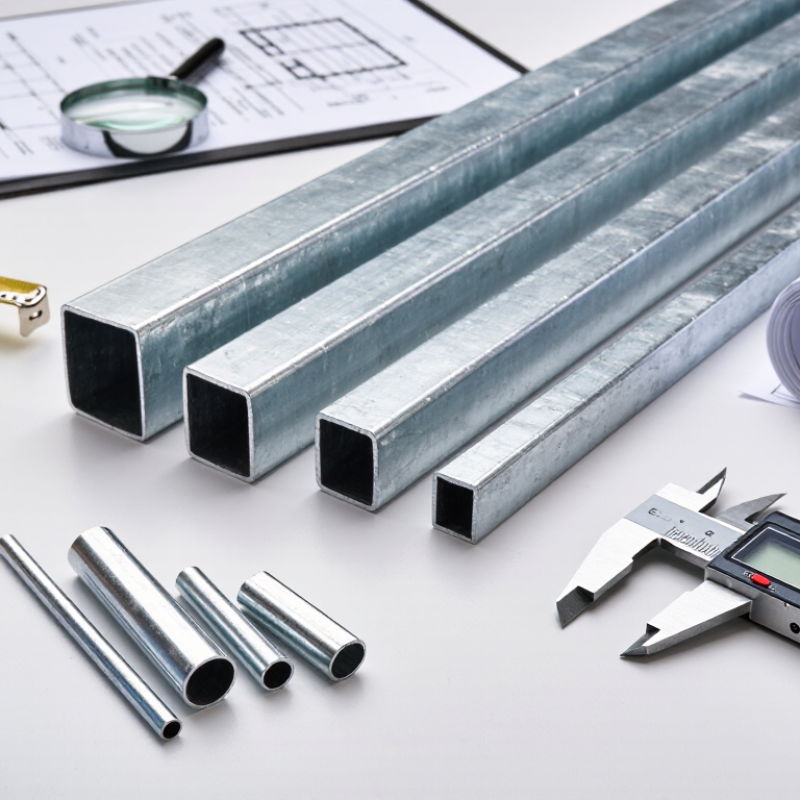
Measure the outside width and height carefully. A 50 mm square tube may not fit a bracket designed for 48 mm. Check whether dimensions are nominal or actual. Then define the wall thickness, such as 2.0 mm or 3.0 mm. Thicker walls usually improve stiffness and resistance to denting, but they add weight and cost. The first estimate is often wrong. Recheck the load, span, connection method, and available installation space.

Also specify the zinc coating requirement and surface condition. Ask about coating mass, uniformity, and areas affected by cutting or welding. Inspect several pieces for peeling, bare spots, heavy runs, and blocked openings. Small flaws matter in outdoor assemblies. In field checks, buyers often measure only one tube. That is not enough. Sample multiple bundles, verify the mill certificates, and compare actual thickness with the purchase specification. Leave room for dimensional tolerance, because production is rarely perfect.

Check Zinc Coating Standards and Corrosion Protection

7 Tips for Buying Galvanized Square Tube

Check the required zinc coating standard before comparing prices. ASTM, EN, and ISO documents may use different coating classes and test methods. Do not treat “galvanized” as a complete specification. Ask for the coating mass or average thickness, not only a sales description. A reliable supplier should provide mill certificates, inspection records, and test results from recognized methods.

Inspect the tube surface under good light. The coating should look continuous, without bare patches, deep scratches, peeling, or heavy ash deposits. Measure wall thickness and outside dimensions at several points. Galvanizing can slightly affect dimensions. Small variations may matter when tubes must fit tightly. Check welded corners carefully, because uneven preparation can reduce zinc coverage there. Fresh cut ends also deserve attention. They need suitable repair treatment when the application requires continuous corrosion protection.

Consider the exposure environment. Indoor storage, coastal air, chemical fumes, and constant moisture demand different protection levels. Ask whether the steel was cleaned and prepared correctly before dipping. Poor preparation can leave weakly bonded areas, even when the surface appears bright. I have seen attractive tubes fail early around cut edges and trapped water. That experience is easy to overlook. Keep tubes dry, separated, and ventilated during storage. Do not stack wet bundles tightly. Finally, confirm packaging, traceability, delivery tolerance, and the exact standard edition stated on the purchase documents.

7 Tips for Buying Galvanized Square Tube - Check Zinc Coating Standards and Corrosion Protection

Tip Buying Check Recommended Requirement Useful Measurement or Standard Why It Matters
1 Confirm the tube dimensions Specify outside width, outside height, wall thickness, length, corner radius, and dimensional tolerances before ordering. For structural hollow sections, ASTM A500 provides commonly used requirements for outside dimensions, wall thickness, strength, and testing. Confirm the applicable edition and product grade. Correct dimensions ensure fit-up, load capacity, and compatibility with joints, brackets, and cutting equipment.
2 Check the zinc coating standard Request hot-dip galvanizing after fabrication when durable, continuous zinc protection is required. ASTM A123/A123M covers zinc coatings on iron and steel products fabricated after galvanizing; ISO 1461 covers hot-dip galvanized coatings on fabricated iron and steel articles. A named standard establishes coating, inspection, appearance, and acceptance requirements instead of relying on a vague “galvanized” description.
3 Match coating thickness to steel thickness Use the minimum coating values specified by the selected standard and project conditions; do not compare products only by surface appearance. Under ISO 1461, typical minimum average coating thickness values are 55 μm for steel 1.5–3.0 mm, 70 μm for >3.0–6.0 mm, and 85 μm for >6.0 mm. Local minimum values are lower: 45, 55, and 70 μm respectively. Thicker steel generally requires a thicker specified zinc coating to achieve the required corrosion protection and standard compliance.
4 Ask how coating thickness is verified Require documented inspection results and confirmation of the test method used for the finished tube. Magnetic thickness gauges are commonly used for non-destructive measurement on ferrous steel. Sampling, calibration, and acceptance should follow the specified standard. A measured coating value is more reliable than visual brightness, which can vary with cooling, alloy chemistry, and surface condition.
5 Inspect coverage and surface condition Look for exposed steel, bare spots, peeling, flaking, sharp zinc lumps, excessive runs, blocked holes, and damage from handling. A compliant galvanized surface should be sufficiently continuous and free from defects that interfere with intended use. Small cosmetic variations may be acceptable when permitted by the governing standard. Defects can reduce corrosion resistance, affect assembly, or require repair before installation.
6 Plan for cut edges and field damage Specify an approved repair procedure for exposed steel caused by cutting, drilling, welding, or transport damage. ASTM A780/A780M provides practices for repairing damaged or uncoated areas of hot-dip galvanized coatings using suitable zinc-based repair materials or other accepted methods. Even a well-galvanized tube can develop localized corrosion if damaged areas are left unprotected.
7 Evaluate the service environment Consider humidity, road salt, industrial chemicals, marine exposure, contact with dissimilar metals, drainage, and expected service life. For severe or permanently wet exposure, consider a duplex system—galvanizing plus a compatible paint or powder coating—after suitable surface preparation. Corrosion protection depends on both coating quality and the environment; no single coating thickness suits every application.

Buyer’s documentation checklist: product dimensions, steel grade, galvanizing process, applicable standard and edition, coating-thickness records, inspection report, repair requirements, and packaging or handling instructions.

Compare Manufacturing Quality, Strength, and Surface Finish

7 Tips for Buying Galvanized Square Tube

Compare manufacturing quality before comparing prices. Ask how the tube is formed, welded, and galvanized. A consistent corner radius often shows controlled production. Check the mill certificate for steel grade, wall thickness, and coating details. Do not trust a bright surface alone. Bright is not always durable.

Strength depends on more than the stated size. Confirm the actual wall thickness with a caliper, especially near corners and weld seams. Review yield strength, tensile strength, and load requirements for your project. Tubes with the same outside dimensions can perform very differently. I have seen thin walls pass a quick visual check, then deform during cutting. That mistake is expensive.

Inspect the surface under good lighting. Look for bare spots, heavy zinc drips, peeling, cracks, and dark weld areas. A smooth coating supports cleaner handling and easier painting. However, minor visual marks may not affect structural performance. Ask whether the supplier follows recognized testing procedures and can provide inspection records. Keep samples from different production batches when consistency matters. This step is often skipped. It should not be. Consider cut ends carefully, because unprotected edges can corrode faster. Apply a suitable repair coating when required by the project specification. My own preference is to compare three samples, measure them, and record the findings before ordering. It takes time, but assumptions cause more trouble than careful checking.

Verify Supplier Certifications, Tolerances, and Custom Options

Buying galvanized square tube starts with paperwork, not shiny zinc. Ask for a current ISO 9001 certificate, its scope, site address, and expiry date. The 2023 ISO Survey recorded 1,265,216 ISO 9001 certificates worldwide. That figure shows adoption, not automatic product quality. Request mill test reports showing heat number, chemistry, yield strength, tensile strength, and the galvanizing process. Match each document to the delivered bundle.

Define tolerances before requesting prices. ASTM A500/A500M is widely used for structural tubing and specifies dimensional and mechanical requirements. Do not accept “standard tolerance” without numerical limits. Measure width, height, wall thickness, and squareness at several points. Corners deserve attention. Ask whether dimensions are measured before or after galvanizing, because coating can affect fit. This detail is often missed.

Custom work requires a controlled drawing. Specify cut length, hole locations, end preparation, weld-seam position, bundle weight, and packaging. For coating, reference ASTM A123/A123M and request recorded thickness readings from each production lot. A first-article inspection can expose problems before full production. For critical applications, independent verification adds useful confidence. One uncomfortable lesson remains: the cheapest quote may hide measurement work, weak traceability, or unclear tolerances. My checklist is not flawless. Leave room for a sample approval.

7 Tips for Buying Galvanized Square Tube: Verify Supplier Certifications, Tolerances, and Custom Options

Use the coating thickness as one verification point when reviewing galvanized square tube documents. The chart shows the minimum average and local zinc coating thicknesses specified by ISO 1461 for fabricated iron and steel products by material thickness. Ask suppliers to provide the applicable galvanizing standard, mill test certificate, dimensional tolerances, inspection results, and confirmation of custom sizes or cut lengths.

Reference: ISO 1461 minimum zinc coating thickness requirements. Values are shown in micrometres (µm).

Evaluate Pricing, Delivery Terms, and Long-Term Value

7 Tips for Buying Galvanized Square Tube

Evaluate the full price, not only the mill quote. Tip 1: Request steel grade, wall thickness, tube length, zinc coating mass, tolerances, and testing documents. A cheaper tube may use thinner walls or lighter galvanizing. Tip 2: Compare landed cost, including cutting, packaging, duties, inland freight, and unloading. The World Steel Association reports that construction consumes roughly half of global steel demand, so regional demand can quickly change quotations. Tip 3: Ask whether prices remain fixed until shipment. They often do not.

Delivery terms can quietly reshape your budget. Tip 4: Confirm the delivery basis, loading port, transport mode, and responsibility for damage. Ask for a dated production schedule, not “soon.” Tip 5: Separate manufacturing time from transit time. A four-week lead time may exclude port delays, inspection, and customs clearance. Add buffer days. OECD’s Steel Outlook 2024 projected global excess capacity could reach 721 million tonnes by 2027, which may pressure prices but also create irregular production schedules.

Long-term value requires evidence. Tip 6: Check coating thickness by batch, dimensional inspection results, and corrosion warranty language. USGS Mineral Commodity Summaries 2025 estimated 2024 global zinc mine production at about 12 million metric tons; zinc costs can influence galvanizing surcharges. Tip 7: Calculate service life, maintenance exposure, replacement labor, and scrap value. My first quote comparison ignored storage damage and twice-handled freight. That mistake was expensive. Consider local climate, open ends, drainage, and whether field cutting will expose unprotected steel. Fancy spreadsheets can still miss practical losses.