Leave Your Message
Choosing an I Beam Construction supplier is a structural decision, not merely a purchasing task. The supplier affects safety, schedule, documentation, and long-term maintenance.
The World Steel Association reported 1.89 billion tonnes of crude steel production in 2023. This scale suggests strong global capacity, but capacity alone proves little. Buyers still need verified material grades, traceable mill certificates, accurate cutting, and dependable delivery. The American Institute of Steel Construction (AISC) also emphasizes qualified fabrication, documented quality systems, and competent inspection throughout steel projects.
Charles J. Carter, former AISC president, advises project teams to “get the steel fabricator involved early.” That guidance remains practical. Early supplier involvement can reveal connection problems before fabrication begins. It can also improve shop drawings, transport planning, and erection sequencing.
Look beyond the lowest quotation. Check whether the supplier understands ASTM A992, EN 10025, or the specification governing your project. Confirm welding qualifications, dimensional tolerances, coating procedures, and non-destructive testing capabilities. Ask for recent project references with comparable spans, loads, and delivery conditions.
A reliable supplier should answer clearly. Vague certificates are warning signs. Delayed replies matter, too.
Dodge Construction Network’s 2024 industry outlook continued to identify labor pressure, material costs, and project delays as major construction concerns. Therefore, supplier resilience deserves careful review. Examine inventory access, backup mills, logistics partners, and contingency procedures.
The process is not perfect. A polished website can hide weak production controls. References can also be selective. Independent verification remains essential. Choose the supplier whose evidence is strongest, not whose promise sounds easiest.
Before choosing an I-beam construction supplier, define the project’s actual demands. Confirm span length, design loads, connection details, corrosion exposure, fire rating, and installation access. A warehouse beam near coastal air needs different protection from an indoor office frame. Small details matter.
Specify the required steel grade, section size, length tolerance, straightness, surface condition, and mill certificates. ASTM A992 commonly requires a 50 ksi minimum yield strength for structural shapes. However, the final grade must match the engineer’s design and local code. The American Institute of Steel Construction’s Steel Construction Manual provides design and detailing guidance, but it does not replace project-specific engineering. Ask suppliers for traceable test reports, not attractive promises.
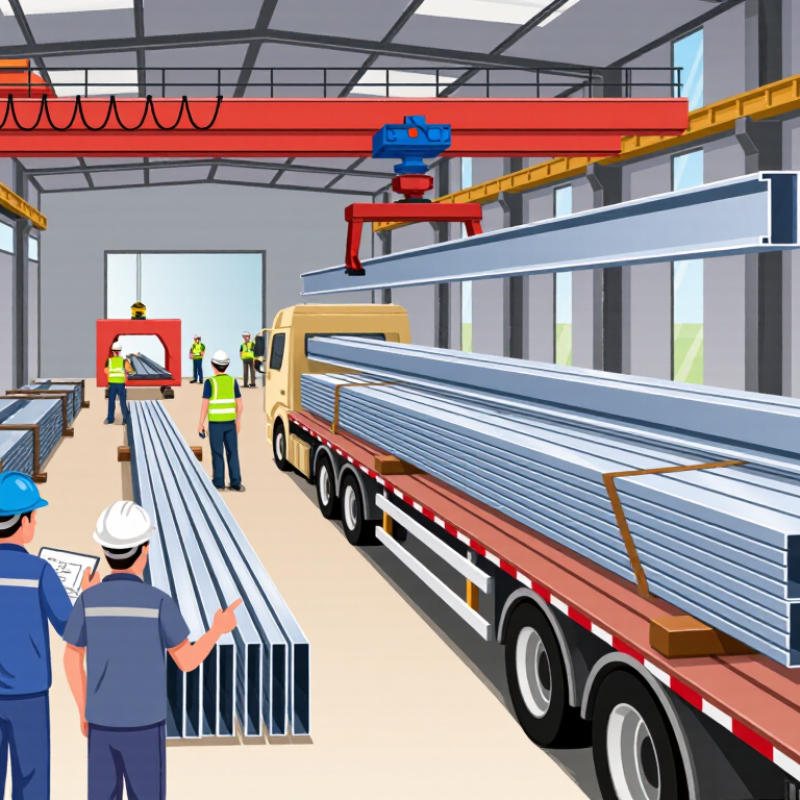
Delivery capacity also deserves careful review. World Steel Association’s World Steel in Figures 2024 reported about 1.89 billion tonnes of crude steel production in 2023. High production does not guarantee accurate fabrication or dependable delivery. Request sample inspection records, cutting tolerances, welding qualifications, and packaging photos. Check how beams are supported during transport. Bent flanges create expensive site problems.
Do not ignore sustainability. The International Energy Agency estimates steelmaking produces roughly 2.5 gigatonnes of direct CO2 emissions annually. Recycled content, efficient nesting, and low-waste cutting can reduce project impact. A practical mistake is accepting the lowest quotation too quickly. I have seen unclear specifications create more cost than higher material prices. Review the drawings again. Some requirements may still be missing.
| Requirement Dimension | Typical Project Requirement or Data | Why It Matters | Supplier Information to Request |
|---|---|---|---|
| Beam Type | Hot-rolled I-section or wide-flange section, selected according to the structural design. | Section geometry controls bending strength, shear capacity, deflection, and connection details. | Section designation, nominal depth, flange width, web thickness, flange thickness, and mass per metre. |
| Nominal Size | Specify the required depth and width in millimetres or inches, together with the approved section designation. | A small change in section size can significantly affect stiffness, weight, and connection fit-up. | Dimensional datasheets, section-property tables, and confirmation that supplied dimensions match the approved design. |
| Steel Grade | Common examples include ASTM A36 with a minimum yield strength of 36 ksi, ASTM A572 Grade 50 with 50 ksi, or EN 10025 S355 with a nominal yield strength of 355 MPa. | Yield strength and tensile properties determine the beam’s design resistance and allowable loading. | Material standard, grade, chemical composition, mechanical test results, and certificate of compliance. |
| Design Loads | Provide dead load, live load, equipment load, snow load, wind load, seismic load, and any impact or vibration requirements applicable to the project. | The supplier needs the design basis to quote the correct section and avoid under-sizing or unnecessary over-sizing. | Load summary, load combinations, design assumptions, and confirmation of the responsible structural engineer’s approval. |
| Span and Support Conditions | State clear span, bearing length, support type, continuity, lateral restraint, and whether the beam is simply supported, continuous, or cantilevered. | Support conditions directly affect bending moments, reactions, buckling, and deflection. | Approved drawings, span schedule, bearing details, and handling or erection requirements. |
| Length and Cutting | Define required piece lengths, allowable cutting tolerance, end squareness, bevels, holes, slots, and any shop fabrication. | Accurate fabrication reduces site cutting, material waste, connection delays, and installation problems. | Cutting schedule, fabrication drawings, dimensional inspection report, and identification marks for each piece. |
| Dimensional Tolerances | Use the tolerance requirements specified by the applicable product standard, such as ASTM A6/A6M or EN 10034. | Tolerances affect connection alignment, column fit-up, bearing contact, and interchangeability. | Applicable tolerance standard, inspection method, calibrated measuring equipment, and recorded results. |
| Weldability | Specify welding process, joint type, welding consumables, preheat requirements, and whether the steel must meet a low-carbon or controlled-carbon requirement. | Chemical composition and thickness influence heat input, hydrogen cracking risk, and weld procedure selection. | Mill test certificate, carbon equivalent information where required, welding procedure specifications, and welder qualification records. |
| Connection Requirements | Define bolted or welded connections, bolt-hole diameter and spacing, connection plates, stiffeners, copes, notches, and end-plate details. | Connection geometry must be coordinated with the beam section and the structural design. | Connection drawings, hole-location tolerances, fabrication capability, and inspection records. |
| Corrosion Protection | Select uncoated steel, shop primer, paint system, hot-dip galvanizing, or another approved protection system based on the exposure environment. | Moisture, salts, chemicals, and outdoor exposure can reduce service life if the protection system is unsuitable. | Surface-preparation grade, coating type, dry-film thickness, inspection procedure, and repair requirements. |
| Fire Performance | State the required fire-resistance rating and whether fireproofing, encasement, or an approved intumescent coating is needed. | Structural steel loses strength and stiffness at elevated temperatures and may require additional protection. | Fire-protection system data, tested thickness, compatibility information, and installation requirements. |
| Traceability | Require heat numbers or batch identification to remain linked to each beam throughout fabrication and delivery. | Traceability supports quality control, compliance verification, and investigation of nonconforming material. | Heat-number records, permanent markings, batch records, and material identification procedures. |
| Quality Testing | Require tensile testing, yield-strength verification, elongation data, chemical analysis, and additional non-destructive testing when specified. | Testing confirms that the supplied material meets the specified standard and project quality plan. | Mill test certificates, inspection and test plan, laboratory accreditation details, and nonconformance procedure. |
| Delivery and Packaging | Define required delivery dates, shipment sequence, maximum bundle weight, lifting points, site access limitations, and storage conditions. | Logistics planning prevents site congestion, handling damage, and delays to the construction schedule. | Lead time, production schedule, packing list, transport plan, delivery inspection process, and damage-claim procedure. |
| Documentation | Require drawings, material certificates, dimensional reports, coating records, welding documents, packing lists, and certificates of conformity. | Complete documentation supports approvals, inspections, payment, future maintenance, and regulatory compliance. | Document index, submission schedule, revision control, and digital file format. |