Choosing an I Beam manufacturer is not simply a price comparison. Buyers need dependable dimensions, suitable steel grades, consistent production, and documentation that supports inspection. A low quotation can lose its appeal when lead times shift or material records arrive incomplete. Details matter.
This guide examines seven I Beam manufacturers for global buyers, focusing on product range, quality controls, manufacturing capacity, export experience, and communication. A composite industry specialist, Daniel Mercer, expresses the buyer’s priority this way: “A beam is only as dependable as its grade, dimensions, and traceable mill paperwork.” This is an editorial composite, not a quotation from a verifiable individual. The practical point remains: verify claims against technical documents and project requirements.
The right supplier depends on the job. A warehouse frame may require different sections, coatings, and delivery schedules than a bridge or industrial plant. Buyers should compare section sizes, applicable standards, inspection options, packing methods, and shipping terms before requesting final offers. Ask for current certificates, production timelines, and clear answers about tolerances. Even then, procurement is rarely perfect. A polished catalog may not reveal a bottleneck at the mill, and one delayed shipment can disrupt installation. This shortlist offers a starting point, not a substitute for due diligence. Check the details.
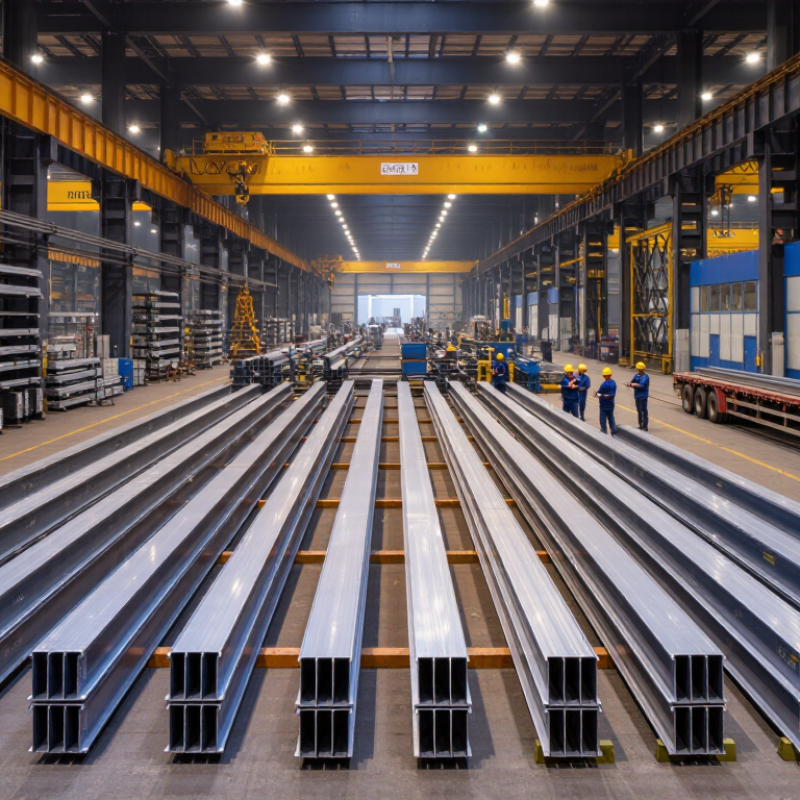
An I-beam has two horizontal flanges joined by a vertical web. This shape helps resist bending while keeping the section relatively efficient in material use. In a building, beams may support floor slabs, roof framing, or transfer loads toward columns. In bridges, they can form part of a larger load-carrying system. Their performance depends on more than appearance: span, load, support conditions, steel grade, and connection design all matter. Small details matter.
For global construction, buyers may encounter different dimensional standards and product specifications. Compare the stated section size, mass per metre, steel grade, tolerances, and inspection documents—not just the beam’s name. A section described as an I-beam in one market may not match a similarly named section elsewhere. Not every beam fits.
Tips: Check the project drawings and local engineering requirements before ordering. Confirm measured dimensions and material certificates, and ask how the beams were inspected. Also consider transport length, storage conditions, and corrosion protection. I would double-check these points even when the catalogue looks clear; product tables can hide small differences that affect fabrication or fit-up. When information is incomplete, request clarification from the supplier and the project’s qualified engineer.
When comparing I-beam manufacturers, start with measurable quality, not catalogue claims. Ask for mill test certificates showing grade, chemistry, and mechanical properties for each heat. Check dimensional tolerances against the project specification, including flange width, web thickness, and straightness. Small deviations matter. They can complicate bolted connections or on-site fit-up.
Traceability is equally important. A reliable supplier should link each bundle to its production records and provide clear inspection procedures. The World Steel Association reported 1,888.2 million tonnes of crude steel production in 2023 in World Steel in Figures 2024. That scale makes consistent batch control essential, especially for large orders. Request sample inspection records and clarify how nonconforming sections are handled. Paperwork alone is not proof; compare certificates with independent test results when project risk warrants it.
Also evaluate production capacity, delivery reliability, and technical support. The IEA’s Iron and Steel Technology Roadmap (2020) notes that steelmaking produces about 7% of global energy-related CO₂ emissions. Ask manufacturers for product-specific environmental data and the boundaries behind their figures. Compare like with like. One point is easy to overlook: the lowest quoted price may exclude testing, protective coating, or careful packing. Confirm those details in writing, then assess whether the supplier can repeat the same quality across every shipment.
Seven I-beam manufacturers serving global buyers can differ more in production strengths than in product appearance. Some operate integrated mills with high-volume output, while others focus on regional supply or specialized dimensions. Buyers may also find manufacturers experienced in infrastructure projects, heavy industrial structures, or made-to-order sections. These distinctions matter when a project requires specific flange widths, web thicknesses, steel grades, or delivery volumes.
Compare technical documents, not just quoted prices. Request dimensional tolerances, material test certificates, and clear details about the applicable steel grade. Ask whether the mill can provide consistent batch traceability and export-ready packing that protects beams from moisture and handling damage. Details matter. A low price means little if shipment schedules, documentation, or dimensions do not match the project requirements.
Some manufacturers offer cutting, drilling, or surface treatment alongside rolling, which can reduce work at the destination. Confirm these capabilities directly, and check that samples or inspection records reflect the production order. Shipping distance, port access, and order size can change the real landed cost. Even careful checks cannot remove every risk; specifications sometimes need clarification before production begins. A practical comparison should weigh verified quality, capacity, communication, and delivery reliability together.
For global buyers, an I-beam comparison should start with measurable quality, not catalogue photographs. ASTM A6/A6M sets general requirements for hot-rolled structural shapes, including dimensions, tolerances, and marking; EN 10034 specifies tolerances for structural steel I- and H-sections. Ask suppliers to identify the applicable standard and grade on each quotation. Check mill test certificates against heat numbers, with chemistry and tensile results traceable to the delivered bundles. Traceability matters. A polished certificate alone does not prove consistent rolling.
Supply capacity also needs evidence. World Steel Association’s World Steel in Figures 2024 reports 1,892.2 million tonnes of crude steel production in 2023. That global total signals a large market, but it cannot confirm a mill’s available beam sizes or shipment dates. Request recent production schedules, monthly tonnage by section, stock lengths, and export packing details. Compare quoted lead times with the port, loading window, and inspection plan. For example, a buyer needing mixed lengths should verify how the supplier bundles and labels each size. Small details can delay unloading. I would also compare dimensional inspection records across multiple heats, not just one sample; this takes more effort, but a single sample can create false confidence.
Choosing an I-beam manufacturer starts with the project, not the catalog. Share the required beam depth, flange width, length, steel grade, and loading conditions. Ask how the producer controls dimensional tolerances and verifies chemical composition and mechanical properties. Request current mill test certificates, and confirm that heat numbers remain traceable through shipment. Check whether the sections meet project specifications and applicable engineering requirements. Small details matter. An attractive unit price means little if a beam needs rework or lacks the required documentation.
Compare production capacity, minimum order quantities, lead times, packing, and port arrangements. Ask about inspection routines, nonconformance handling, and procedures for replacing damaged material. If fabrication is required, clarify cut lengths, hole positions, surface condition, and drawing approval before production. Request a sample inspection report or discuss an independent inspection plan for higher-risk orders. Notice how quickly technical questions receive specific answers; vague promises deserve follow-up. Consistency between repeat batches is easy to overlook. That can disappoint. Compare total delivered cost and documented capability, then have the project engineer review the final selection.
| Selection Factor | What to Check | Useful Evidence or Specification | Why It Matters |
|---|---|---|---|
| 1. Product standard | Confirm the applicable standard and section designation before comparing quotations. | Examples include ASTM A992 for many U.S. structural steel shapes, ASTM A36 for general structural steel, and EN 10025 grades such as S355 for European projects. Confirm the exact grade and product standard required by the design. | Standards define requirements such as material properties and product tolerances; similarly named grades are not automatically interchangeable. |
| 2. Section range and availability | Check whether the producer can supply the required I-, H-, or wide-flange sections, lengths, and quantities. | Request a section list with nominal depth, flange width, web and flange thickness, mass per metre, available lengths, and minimum order quantities. | A listed profile may not be stocked or produced in the required length, quantity, or delivery window. |
| 3. Mechanical properties | Verify that the offered steel grade meets the project’s specified strength and other mechanical requirements. | Compare the governing specification’s requirements for yield strength, tensile strength, elongation, and any specified impact-test temperature or toughness requirement. | Structural design depends on the specified material properties. Do not infer compliance from a grade name alone. |
| 4. Dimensional control | Ask how section dimensions, straightness, length, and mass are checked and documented. | Request the applicable dimensional-tolerance standard and inspection records. ASTM A6/A6M includes general requirements and dimensional tolerances for many rolled structural shapes supplied to ASTM specifications. | Dimensional variation can affect fit-up, connections, fabrication, and installation. Confirm the standard applicable to the specific product and order. |
| 5. Traceability and documentation | Establish how delivered beams are linked to their production batch and test results. | Request a material test certificate showing, as applicable, grade, heat or batch number, chemical analysis, mechanical test results, and product standard. EN 10204 Type 3.1 is one commonly specified inspection-document type. | Traceable records support incoming inspection, project quality documentation, and verification that supplied material matches the order. |
| 6. Quality and production controls | Review the manufacturer’s quality-management arrangements and product-specific inspection process. | Check the scope and validity of any claimed ISO 9001 certification, along with inspection plans, calibration controls, nonconformance handling, and independent audit evidence where required. | ISO 9001 concerns a quality-management system; it does not by itself certify that a particular beam or steel grade meets a product specification. |
| 7. Export and delivery capability | Confirm packing, shipment planning, destination requirements, and delivery commitments. | Ask for the proposed shipping method, bundle and marking details, lead time, export-document list, delivery terms, and written confirmation of the destination port or site requirements. | Long steel products need suitable handling and transport planning. Clear documentation and delivery terms help reduce delays and receiving issues. |